Contact us: 7208019100
Dress Code for Interview: What to Wear & What to Skip
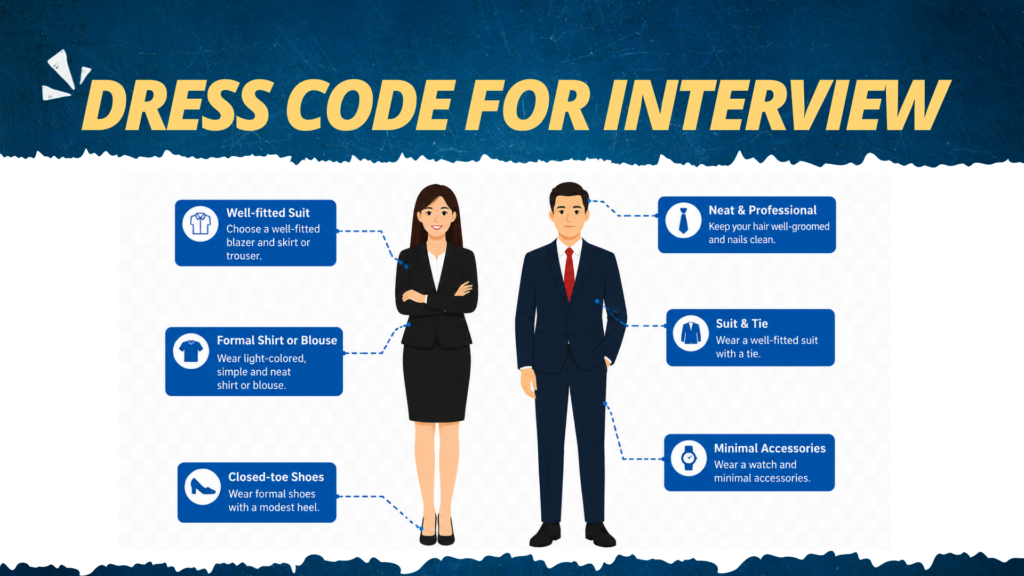
Nobody actually tells you the whole truth about the dress code for interview day. You get the usual stuff — “wear something professional,” “avoid bold colors,” “iron your shirt.” And then you show up, and you realize the advice you got was written for a world that doesn’t quite exist anymore. The startup that says it’s “super casual” still judges you if you show up looking like you rolled out of bed. The corporate firm that says “business formal” doesn’t mean you need to look like a Victorian banker either.
I’ve spent years observing what actually happens in hiring rooms — not just reading style guides, but paying attention to the moments where an outfit subtly changed the energy of an interview. This guide is built on that. It’s for real people with real wardrobes, interviewing at real companies across every kind of industry. No fluff. No recycled clichés. Just the honest, complete picture of how to dress for an interview in 2025.
The dress code for interview conversation has changed. And if you’re still following five-year-old advice, you may be optimizing for a game that’s already moved on without you.
Why the Dress Code for Interview Has Quietly Shifted
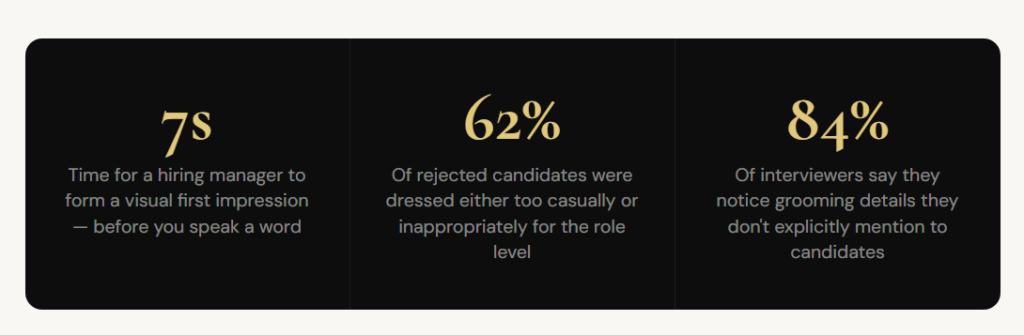
Here’s something most style guides won’t admit: the dress code for interview today is no longer about following a single fixed rule. It’s about reading signals correctly and making smart judgment calls. That’s both more freeing and more demanding than the old binary of “formal vs. casual.”
A few things have genuinely changed since 2020. Remote work normalized casual clothing in a way that seeped into interview expectations — but not evenly. A technology company in Bengaluru runs its interviews very differently from a private equity firm in Mumbai’s BKC district. A media startup in Andheri has a completely different culture from a pharmaceutical multinational in Powai. Same city. Completely different dress codes.
The shift that matters most is this: the dress code for interview is now less about industry category and more about specific company culture. Two companies in the same industry can have wildly different expectations. The companies that have “culture fit” as an evaluation criterion — and most do — use your outfit as early evidence of whether you’ve done your research.
This is why the generic advice fails people. “Wear something professional” doesn’t tell you that the growth-stage startup you’re interviewing at genuinely respects the candidate who showed up in well-fitted dark jeans and a good blazer over the one who wore an ill-fitting formal suit they bought last week. Nor does it explain that the same blazer-and-jeans look would read as lazy and under-prepared at a law firm partner interview.
The Four-Level Dress Code for Interview Framework
Think of the dress code for interview spectrum as four distinct levels. Each has its own signals, its own acceptable variations, and — critically — its own failure modes. Most bad outfit choices happen not because someone dressed badly in absolute terms, but because they chose the wrong level for the room they were about to walk into.
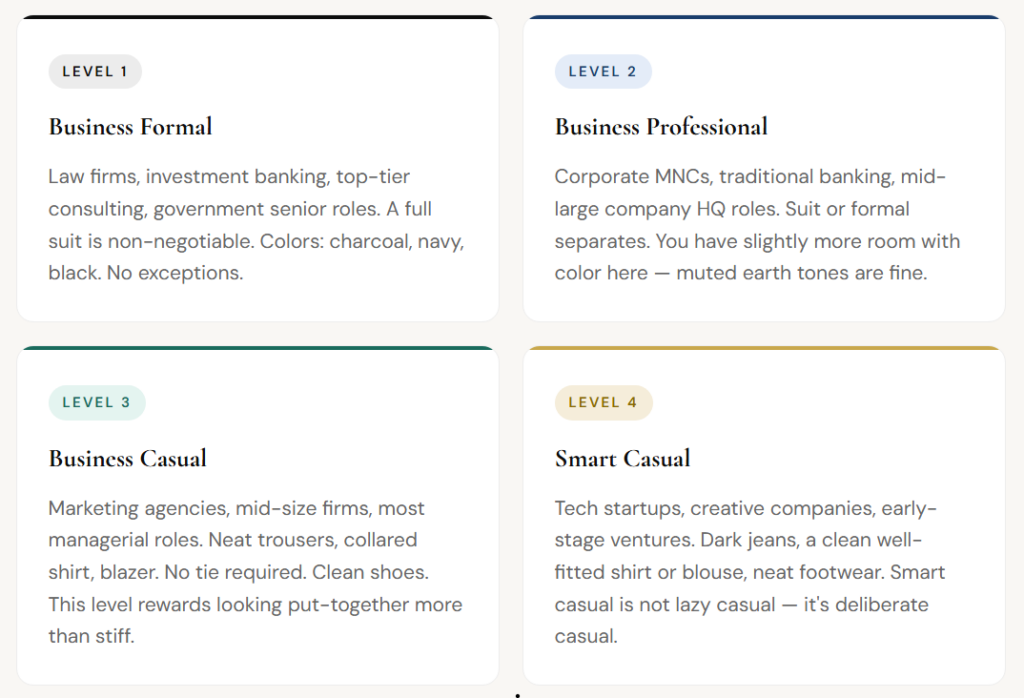
The single most useful piece of advice in the entire dress code for interview conversation: always dress one level higher than the company’s everyday standard. If they’re Level 4 in daily life, you show up at Level 3. If they’re Level 2 normally, you treat the interview as a Level 1 situation. This one rule alone eliminates most outfit mistakes.
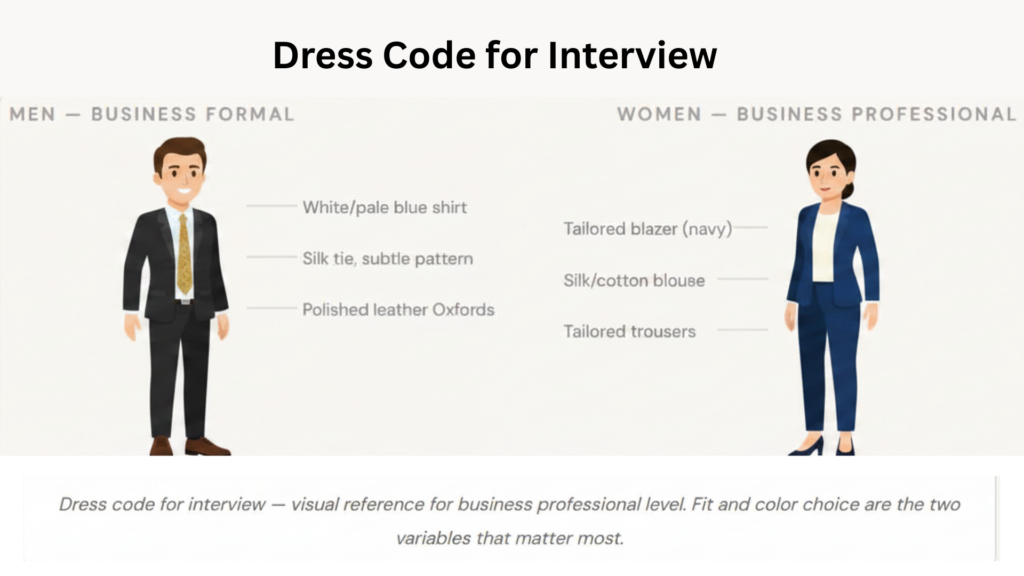
Exactly What to Wear: Men and Women
Think of the dress code for interview spectrum as four distinct levels. Each has its own signals, its own acceptable variations, and — critically — its own failure modes. Most bad outfit choices happen not because someone dressed badly in absolute terms, but because they chose the wrong level for the room they were about to walk into.
The single most useful piece of advice in the entire dress code for interview conversation: always dress one level higher than the company’s everyday standard. If they’re Level 4 in daily life, you show up at Level 3. If they’re Level 2 normally, you treat the interview as a Level 1 situation. This one rule alone eliminates most outfit mistakes.
Color Psychology and the Dress Code for Interview
Color choices in an interview aren’t arbitrary — they’re communicating before you open your mouth. Research in behavioral psychology has consistently found that certain colors trigger specific perception patterns in observers. For the dress code for interview, this matters because you want your color choices to reinforce the qualities you’re trying to convey: competence, trustworthiness, energy, or creativity, depending on the role.
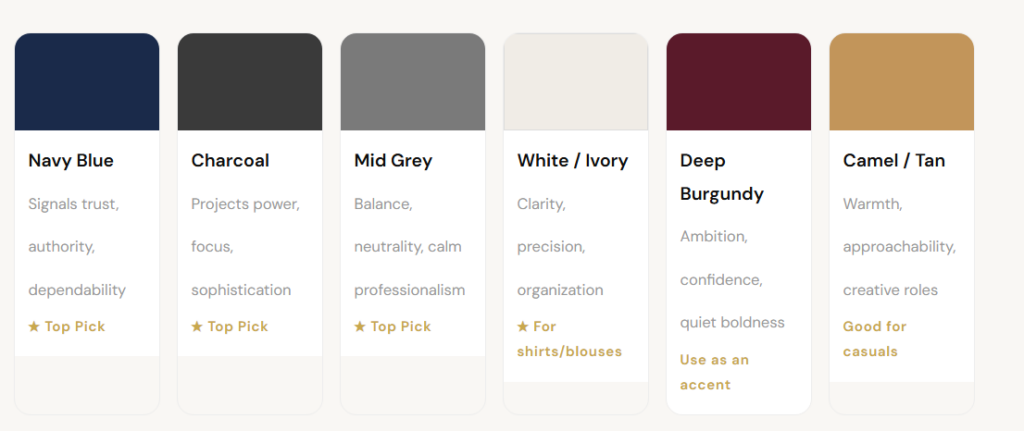
Navy is widely considered the single best main color for the dress code for interview across almost every industry. It uniquely combines authority with approachability — you look like someone who can be trusted and someone who’s easy to work with simultaneously. This is a rare combination that most colors can’t pull off.
The colors worth avoiding at any interview level: bright red as a primary piece (too aggressive — it reads as confrontational before you’ve said a word), orange (casually jovial in a way that undermines serious intent), and yellow (too informal in most professional contexts). Black worn head-to-toe can work in creative industries but can feel severe or even deflating in a small meeting room.

How to Actually Find Out the Dress Code for Interview
The biggest mistake candidates make is guessing instead of researching. Finding out the actual dress code for interview expectation at a specific company takes about 15 minutes and removes all the uncertainty. Here’s exactly how to do it:
- LinkedIn profile photos of current employees. Go to LinkedIn, search the company, and look at the profiles of people in your target department — especially those at your seniority level. What are they wearing in their headshots? What do they look like in company posts and event photos? This is the most accurate, real-time signal of the everyday dress culture at that company. Culture clues live in the photos, not the company website’s “About Us” page.
- Company Instagram and social media. Offices, team days, company events, office Fridays — if a company posts about any of this, you can see exactly what people actually wear. This is especially useful for startups and creative companies who tend to be very active on social. You’ll see whether “casual” means put-together casual or genuinely relaxed casual.
- Glassdoor interview reviews. Go to Glassdoor, find the company, and filter for interview experiences. Candidates who’ve interviewed before often mention what they wore and what others in the waiting room were wearing. This is unfiltered, peer-to-peer intelligence about the dress code for interview at a company level. It’s almost always more accurate than anything on the company’s official channels.
- Ask the recruiter or HR contact — directly. This is dramatically underutilized and has zero downside. When you’re confirming your interview time and location, add one line: “One quick thing — could you give me a sense of the dress code for the interview? I want to make sure I’m dressed appropriately for the office culture.” Every recruiter I’ve ever spoken to has said this question earns more respect than it loses. It signals cultural intelligence and preparedness — two things that are being evaluated from the first contact.
Dress Code for Interview: Virtual Meetings Are Still Real Meetings
The number of candidates who have shown up to video interviews in a neat top and pyjama bottoms is genuinely staggering. And while the camera doesn’t show below the waist, the psychological split between “professional from the waist up” and “completely unprepared everywhere else” comes through in ways that are hard to explain but very real to experience.
The dress code for interview on video calls follows the same principle as in-person: dress for the role, dress for the company culture, dress one level up from everyday. The camera adds specific considerations on top of that.
What looks good on camera: Solid, mid-depth colors — not white (it blows out under common webcam lighting), not busy patterns (they strobe and distract). Navy reads exceptionally well. Soft grey reads well. Muted jewel tones — deep teal, dusty rose, rich burgundy — photograph beautifully and give you visual presence without being distracting. Structure also reads better on camera: a blazer collar and lapel give the eye clean lines to settle on.
What gets worse on camera: Fussy or shiny fabric (it catches light oddly), very small repeating patterns (visual noise), and anything that makes you look flat or washed out. Your background and lighting are now part of your presentation. A clean wall, a bookshelf, or a simple backdrop behind you reinforces the professional impression your dress code for interview choice is trying to make. Clutter or a messy room undermines it the same way a wrinkled jacket does in person.
Grooming, Accessories, and the Finishing Layer
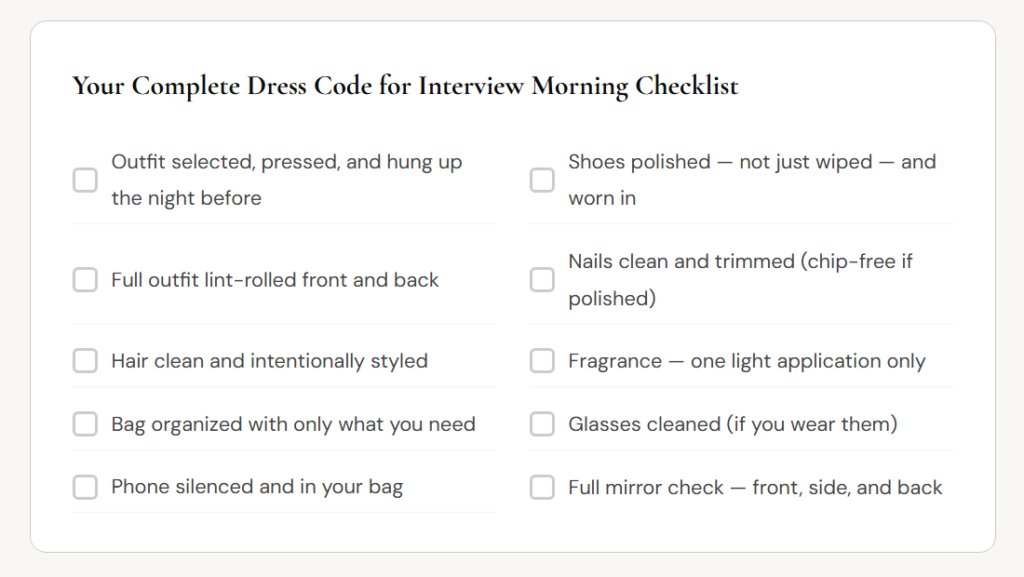
The dress code for interview extends beyond fabric. The details — grooming, fragrance, bag, accessories — are where candidates who are otherwise well-dressed either nail the impression or quietly undermine it. Interviewers process these details in fractions of seconds without consciously listing them, but the aggregate impression is very real.
Fragrance: This deserves its own paragraph because it’s one of the most commonly mishandled aspects of interview presentation. A light fragrance is fine and even pleasant. A heavy fragrance in a small meeting room with a closed door is genuinely problematic — it can cause headaches, trigger allergies, and create an immediate negative association with you that has nothing to do with your competence. The rule is one application, applied to pulse points, not sprayed into the air and walked through. If you can smell your own cologne or perfume clearly when you’re sitting still, it’s too much.
Bag or portfolio: Bring something structured and neat — a slim leather portfolio, a clean briefcase, or a structured tote. A worn-out backpack or a plastic bag with papers sticking out of it disrupts an otherwise professional dress code for interview look in a way that’s hard to recover from. You don’t need to spend a lot — a neat, structured bag from any mid-range brand reads professionally.
Jewelry and accessories: The standard is minimal, purposeful, and quiet. One watch (analog, not a smartwatch in chunky plastic). Stud earrings or small hoops. A simple bracelet if you wear one regularly. The goal is nothing that moves, makes noise, or draws the eye away from your face and words. The interview is about you — your accessories should not compete with that.
What Getting Dressed Right Actually Does to Your Brain
There is a real and documented psychological phenomenon called enclothed cognition. In simple terms: the clothes you wear affect the way you think. When you put on clothing associated with authority, competence, and professionalism, your actual cognitive performance shifts — you become more focused, more confident, and more precise in your communication. This is not metaphor. It’s been tested and replicated.
What this means practically for the dress code for interview: getting dressed well isn’t just about the impression you make on someone else. It’s about the impression you make on yourself before you walk in. Candidates who feel put-together walk differently. They make stronger eye contact. They pause before answering instead of rushing. They project the kind of settled confidence that reads as executive presence even in junior candidates.