
Menu
Contact us: 7208019100
STAR Method Strategy 2025 | Tips & Examples

INTRODUCTION
When you walk into an interview, one of the biggest challenges isn’t answering questions — it’s answering them the right way. Many candidates fail not because they lack skills but because they struggle to communicate their experiences effectively. This is where the STAR Method Strategy becomes your secret weapon for success.
The STAR Method Strategy is a structured approach to answering behavioral interview questions. Instead of giving vague or scattered responses, it helps you present your story in a clear, concise, and impactful way. Recruiters often ask behavioral questions like:
“Tell me about a time when you faced a challenge at work.”
“Describe a situation where you had to work in a team.”
“How did you handle a conflict with a colleague?”
Without a strategy, candidates tend to ramble or miss key points. But with the STAR Method Strategy, you organize your answers into four simple steps:
- Situation – Set the context
- Task – Explain your role
- Action – Highlight what you did
- Result – Share the outcome
By following this format, you don’t just answer questions — you tell a compelling story that showcases your problem-solving skills, achievements, and ability to handle real-world situations.
Why It’s Important for Behavioral Interviews
In today’s competitive job market, recruiters want more than just technical knowledge. They want to understand how you think, react, and make decisions in challenging situations. Behavioral interviews are designed to assess your soft skills, problem-solving approach, teamwork abilities, and leadership potential.
The STAR Method Strategy makes this easier by helping you:
- Stay organized and confident
- Provide specific and relevant examples
- Show your personal contribution rather than just team efforts
- Highlight measurable results that make your answers impactful
This approach is especially helpful for freshers and professionals alike. Freshers can use academic projects, internships, or group tasks, while experienced candidates can draw from workplace challenges, achievements, and leadership situations.
How This Strategy Improves Your Interview Performance
Using the STAR Method Strategy gives you a clear competitive advantage. Instead of panicking or improvising on the spot, you approach every behavioral question with a structured, logical flow. Recruiters love this because it:
- Saves interview time
- Makes your answers easy to follow
- Highlights your strengths and achievements
- Demonstrates that you’re well-prepared
When applied effectively, this strategy boosts your confidence and improves your chances of achieving a positive interview result. Whether you’re preparing for your first job or aiming for a career upgrade, mastering the STAR Method Strategy can be the difference between a missed opportunity and your dream role
🚀 Want to increase your placement success in Mumbai? Read this complete strategy guide with practical steps:
👉 know more
Understanding the STAR Full Form
Before you start practicing the STAR Method Strategy, it’s important to understand what STAR actually stands for. Knowing the STAR full form will help you structure your answers more effectively and impress recruiters with clarity and confidence.
The acronym STAR stands for Situation, Task, Action, and Result. Each step has a specific purpose and guides you to create structured, focused, and impactful responses during behavioral interviews. Let’s break it down:
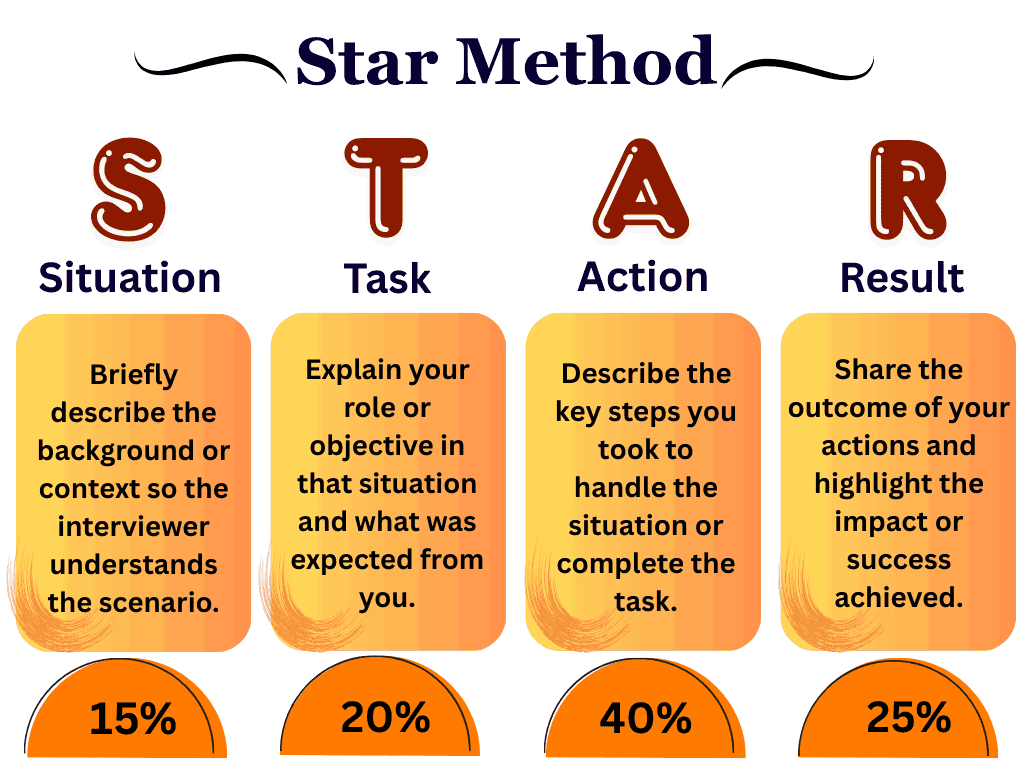
S → Situation – Setting the Background Clearly
Start by describing the context of the situation so the interviewer understands what was happening. Keep it short and relevant — you don’t need to provide every detail, just enough to set the stage.
- Talk about when and where the situation occurred.
- Explain what was happening and why it was important.
- Keep it concise — one or two sentences are enough.
This step helps the interviewer visualize the scenario and prepares them to understand the rest of your answer.
T → Task – Defining Your Role and Objective
Next, focus on your specific responsibility in that situation. The goal is to explain what was expected of you or what challenge you needed to solve.
- Clarify your role in the situation — were you leading, assisting, or contributing?
- Highlight the objective or goal you had to achieve.
- Be precise so the interviewer knows exactly what you were responsible for.
This step shows that you understand your duties and can take ownership of your actions.
A → Action – Explaining Your Personal Contribution
This is the most important part of the STAR Method Strategy because it focuses on what you did to handle the situation.
- Explain the steps you took to complete the task or solve the problem.
- Focus on your individual contribution, not just the team’s efforts.
- Highlight skills like problem-solving, leadership, teamwork, or decision-making.
This section shows recruiters how you think, act, and perform under pressure. Keep it detailed but avoid over-explaining — stick to the key actions that made a difference.
R → Result – Highlighting Outcomes and Achievements
Finally, share the outcome of your actions and explain what you achieved. Wherever possible, include quantifiable results to make your answer stronger.
- Did your solution save time, improve performance, or increase efficiency?
- Did the project succeed because of your contribution?
- Were you appreciated, rewarded, or given more responsibilities afterward?
This step leaves a lasting impression because recruiters are more likely to remember measurable results than vague statements.
Pro Tip: If the result wasn’t entirely successful, focus on what you learned — interviewers value growth and problem-solving skills.
- Kickstart Your Career with ShunyaTattva! 🚀
Ace your interviews and land your dream job with expert guidance from ShunyaTattva Management Consultancy.
Apply Now ✅
Why the STAR Interview Format Works
The STAR interview format has become one of the most popular techniques used by recruiters and hiring managers to assess candidates effectively. It’s widely adopted across industries because it brings clarity, structure, and consistency to both the candidate’s answers and the interviewer’s evaluation process.
Here’s why this format is so effective:
1. Structured and Easy-to-Follow Approach
One of the biggest advantages of the STAR interview format is its simplicity. It breaks down complex behavioral questions into four clear steps — Situation, Task, Action, and Result.
For candidates, this structure provides a roadmap to frame their answers logically, avoiding rambling or confusion. For interviewers, it helps them quickly evaluate your decision-making, problem-solving skills, and the value you bring to the table.
2. Helps You Focus on Relevant Details
Many candidates make the mistake of giving too much background information or going off-topic during interviews. The STAR format helps you stay laser-focused on the most relevant details.
By following the four-step structure, you concentrate on what truly matters —
- What the situation was
- What you had to do
- What steps you took
- What the outcome was
This makes your answer clearer and more impactful, helping you present yourself as a confident and well-prepared candidate.
3. Builds Confidence and Reduces Nervousness
Interviews can be stressful, especially behavioral ones where you’re expected to recall real-life scenarios. The STAR interview format removes much of that anxiety because you already have a proven framework to rely on.
When you prepare examples beforehand, you’re less likely to freeze, forget key points, or give incomplete answers. With STAR, you feel more confident, organized, and in control of your response, which automatically improves your performance.
4. Preferred by Recruiters and Hiring Managers
The STAR interview format isn’t just helpful for candidates — it’s a favorite among recruiters too. Why? Because it makes evaluating candidates easier and more objective.
Instead of listening to long, unstructured stories, hiring managers get concise, result-oriented answers that showcase your skills and achievements clearly. Many companies specifically design their behavioral interview questions to align with STAR, making it a must-know strategy for anyone preparing for interviews.
How to Use the STAR Method Strategy Effectively
Mastering the STAR Method Strategy can transform the way you answer behavioral interview questions. While the concept is simple, applying it effectively requires planning, practice, and precision. By breaking your response into four structured steps — Situation, Task, Action, and Result — you’ll deliver clear, focused, and impactful answers that impress recruiters.
Here’s a step-by-step guide to help you make the most of this strategy:
Step 1 – Understand the Question Carefully
Before you start forming your answer, listen to the question closely. Behavioral interview questions often begin with phrases like:
- “Tell me about a time when…”
- “Describe a situation where…”
- “Give an example of how you handled…”
Understanding the question ensures that you choose the right example and structure your response accordingly. If needed, pause for a moment before answering — this shows you’re thoughtful and focused.
Pro Tip: Pay attention to the specific skill the interviewer wants to assess, like teamwork, leadership, problem-solving, or conflict resolution.
Step 2 – Pick a Suitable Example
Your example is the foundation of your answer. Choose a situation from your work, academics, or internships that directly relates to the question.
- For freshers: Use examples from college projects, group assignments, volunteering, or internships.
- For professionals: Choose workplace scenarios like achieving targets, solving conflicts, handling clients, or managing deadlines.
Make sure your example demonstrates your skills, contribution, and results — avoid irrelevant or overly personal stories.
Step 3 – Structure Your Answer Using STAR
Once you’ve selected your example, structure your answer step by step:
- S → Situation: Set the scene and provide context.
- T → Task: Explain your role and responsibility.
- A → Action: Highlight the steps you took to handle the situation.
- R → Result: Share the outcome and measurable achievements.
This STAR Method Strategy keeps your response organized, ensuring that the interviewer follows your story easily and understands your value.
Step 4 – Keep Your Response Concise and Impactful
Recruiters don’t want long, complicated stories — they want clear, result-oriented answers. Aim to answer each behavioral question in 1–2 minutes.
- Focus only on relevant details
- Avoid unnecessary background information
- Highlight specific achievements and results
If possible, quantify your success:
Example: “My actions improved team efficiency by 30% and reduced project delays.”
Numbers catch recruiters’ attention and make your contribution more memorable.
Step 5 – Tailor Answers Based on the Job Role
Not every job values the same skills. A great answer for a sales role might focus on closing deals, while a project management role might emphasize leadership and organization.
- Study the job description carefully
- Understand the skills and qualities the employer values
- Choose examples that match those expectations
This personalization shows the interviewer that you understand the role and are genuinely interested in contributing to the organization.
STAR Method Resume Tips
The STAR Method Strategy isn’t just useful for answering behavioral interview questions — it can also make your resume stand out. Most candidates list job duties, but recruiters are more interested in results and achievements. By applying the STAR method resume format, you can showcase your skills in a way that highlights your contribution, actions, and impact.
Here’s how to use it effectively:
How to Showcase STAR-Based Achievements on Your Resume
Recruiters scan resumes quickly — often in 6–10 seconds — so you need to grab their attention instantly. Instead of writing generic statements like:
“Responsible for handling customer queries.”
Use the STAR-based approach:
- S (Situation): Briefly describe the context.
- T (Task): Mention what was expected of you.
- A (Action): State what you specifically did.
- R (Result): Highlight the measurable outcome.
Example:
“Resolved 150+ customer queries weekly by implementing a structured tracking system, leading to a 25% reduction in complaint resolution time.”
This format turns ordinary job duties into impact-driven achievements that make your resume stand out from the crowd.
STAR Method Resume Examples for Freshers and Professionals
The STAR method resume works for both freshers and experienced professionals, but the approach differs slightly:
For Freshers:
If you have little to no work experience, highlight college projects, internships, certifications, and volunteer work.
- Example:
“Led a team of 4 in a college project to design a marketing campaign, resulting in a 20% higher engagement rate compared to previous submissions.”
For Professionals:
Experienced candidates should showcase real workplace achievements and quantifiable results.
- Example:
“Spearheaded a social media strategy that increased brand visibility by 40%, driving a 15% boost in lead conversions within three months.”
This approach not only makes your resume data-driven but also aligns perfectly with what recruiters look for — evidence of success.
How a STAR Profile Increases Interview Success
A STAR profile is essentially a well-crafted collection of your best STAR-based achievements. When your resume already highlights situations, actions, and results, you’re better prepared to discuss them confidently during interviews.
- It improves consistency between your resume and interview answers.
- Recruiters remember you better because your examples are structured and result-oriented.
- You look more credible and professional when your resume matches your spoken responses.
Having a strong STAR profile also boosts your confidence. Since you’ve already broken down your achievements using STAR, you’ll have ready-to-use examples for almost any behavioral question, making your overall interview performance stronger.
STAR Method Example Answers for Freshers & Professionals
Understanding the STAR Method Strategy is one thing, but applying it effectively is what truly impresses recruiters. Whether you’re a fresher preparing for your first job interview or an experienced professional facing workplace-related questions, structured examples can make your responses clear, confident, and impactful.
Here are sample answers tailored for both scenarios:
1. STAR Answer Examples for Freshers (College Projects, Internships)
Freshers often worry about not having enough work experience, but the STAR method can still help you frame strong answers by drawing from college projects, internships, events, or volunteer work.
Example Question:
“Describe a challenge you faced during your internship and how you overcame it.”
S → Situation: During my internship at a finance firm, I had to manage large data sets while meeting strict deadlines.
T → Task: I was tasked with analyzing financial reports and preparing summaries for the manager.
A → Action: I created an Excel automation formula to speed up calculations, double-checked the data for accuracy, and worked closely with my supervisor to ensure precision.
R → Result: I completed the task two days earlier than expected, and my manager appreciated my problem-solving skills and efficiency.
Example Question:
“Tell me about a time you successfully worked in a team.”
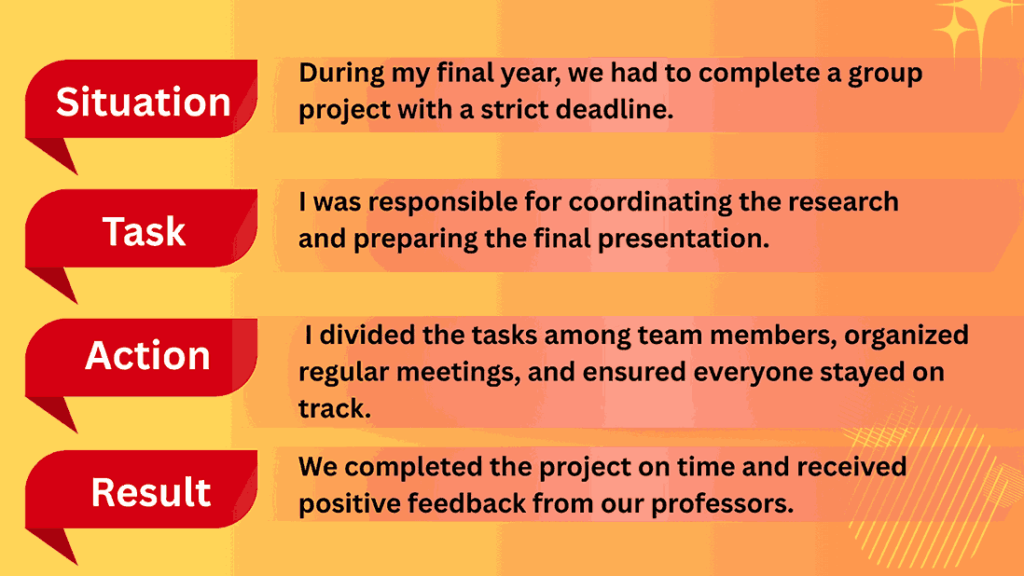
S → Situation: During my final year, we had a college project where our team had to create a digital marketing plan for a local business within four weeks.
T → Task: I was responsible for content research and coordinating with teammates to prepare the final presentation.
A → Action: I created a content strategy, assigned responsibilities, and scheduled regular progress meetings to ensure everyone stayed on track. I also handled the final compilation of the presentation slides.
R → Result: Our project received top marks and was selected as the best submission in the department, improving my confidence and teamwork skills.
2. STAR Answer Examples for Experienced Candidates (Workplace Challenges)
For professionals, the STAR method is a powerful storytelling tool to demonstrate your leadership, decision-making, and problem-solving abilities.
Example Question:
“Give an example of a time you had to handle a difficult client.”
S → Situation: At my previous company, a major client was unhappy with a delayed project delivery, and the situation was escalating.
T → Task: As the account manager, it was my responsibility to resolve the issue and rebuild trust.
A → Action: I scheduled a one-on-one meeting with the client, explained the reasons for the delay, offered a revised timeline, and provided weekly progress reports to maintain transparency. I also collaborated with the internal team to speed up development.
R → Result: The client appreciated our honesty, we completed the project successfully, and the account was renewed for another two years, generating 25% more revenue.
Example Question:
“Describe a time you successfully led a team to achieve a goal.”
S → Situation: At my previous job, our team was tasked with launching a new software product within six weeks.
T → Task: I was leading a team of five developers and coordinating between the design and marketing departments.
A → Action: I created a project timeline, delegated tasks based on individual strengths, monitored progress daily, and conducted stand-up meetings to keep everyone aligned.
R → Result: We launched the product five days ahead of schedule, which resulted in a 30% increase in early sign-ups and positive client feedback.
3. How to Link Your Answers to Interview Results.
Using the STAR Method Strategy effectively isn’t just about structuring answers — it’s about aligning your examples with the company’s expectations and achieving better interview results.
Here’s how to make your responses more impactful:
- Match your examples to the job role: Choose situations that highlight skills relevant to the position.
- Quantify your achievements: Use numbers, percentages, and measurable outcomes to make your contributions stand out.
- Reflect on lessons learned: Even if the result wasn’t perfect, show what you gained from the experience.
- Showcase growth: Highlight how the situation helped you improve professionally.
Pro Tip: Recruiters remember results more than stories. Always end your STAR answer by summarizing your impact, as it leaves a strong final impression and improves your overall interview outcome.
STAR Delta Method – A Quick Overview
When it comes to behavioral interviews, most candidates are familiar with the STAR Method Strategy. However, many top companies, especially in tech and consulting, are now shifting towards the STAR Delta Method — an advanced approach that goes beyond just explaining what you did.
The STAR Delta Method helps candidates highlight improvements, learning, and adaptability after describing the situation, task, action, and result. It focuses on continuous growth, which is a key quality recruiters value today.
1. What is the STAR Delta Method?
The STAR Delta Method is an enhanced version of the traditional STAR technique. It follows the same initial four steps:
- S (Situation): Setting the context
- T (Task): Defining your objective
- A (Action): Explaining what you did
- R (Result): Sharing the outcome
Delta (Δ) → Here’s the difference: You add a fifth step to reflect on what you learned or how you could improve next time.
This additional step shows recruiters that you’re self-aware, adaptable, and open to growth, which are critical traits in today’s fast-changing work environments.
2. How It Differs from the Standard STAR Strategy
Aspect | STAR Method | STAR Delta Method |
Focus | Describes what happened and the outcome | Focuses on results + personal growth |
Structure | Situation → Task → Action → Result | Situation → Task → Action → Result → Delta |
Purpose | Highlights achievements | Highlights achievements and lessons learned |
Recruiter Insight | Understands what you did | Understands how you grow from experiences |
Example Difference:
- STAR Answer: “We delivered the project 2 days early and exceeded client expectations.”
- STAR Delta Answer: “We delivered the project 2 days early and exceeded client expectations. However, I realized our internal communication could be improved, so I suggested weekly stand-ups, which helped us perform even better in the next project.”
This subtle addition demonstrates reflection, problem-solving, and adaptability — traits recruiters love to see.
When Recruiters Prefer STAR Delta Over STAR
Recruiters, especially in top MNCs, startups, and leadership roles, often prefer the STAR Delta Method in interviews because it:
- Shows a growth mindset → Companies want candidates who learn from challenges.
- Highlights adaptability → In fast-changing environments, recruiters value people who improve processes continuously.
- Gives deeper insights → Instead of just focusing on past success, it reveals how you evolve over time.
- Enhances leadership potential → For managerial and strategic roles, recruiters prefer candidates who can reflect, evaluate, and improve.
In short, while the standard STAR method is perfect for explaining what you did, the STAR Delta Method goes a step further by showcasing how you grow, making it a powerful advantage during competitive interviews.
Common Mistakes to Avoid When Using STAR Method Strategy
The STAR Method Strategy is one of the most effective techniques for answering behavioral interview questions, but many candidates make small mistakes that can reduce the impact of their responses.
To make your answers clear, relevant, and memorable, avoid these common pitfalls:
1. Over-Explaining Situations
One of the most frequent mistakes candidates make is spending too much time describing the background. While setting the context is important, recruiters are more interested in your actions and results than every tiny detail.
Tip: Keep your “Situation” brief — ideally, 2–3 sentences. Focus more on what you did and what you achieved rather than giving a long story.
2. Giving Irrelevant Examples
Choosing the wrong example can weaken your answer, even if you structure it well. Your examples should align with the job role and demonstrate the skills the recruiter is looking for.
Tip: Always select examples that highlight problem-solving, teamwork, leadership, or decision-making skills relevant to the position you’re applying for.
3. Forgetting to Focus on Results
Many candidates explain the situation and actions well but forget to mention the outcome. This is a missed opportunity because results make your answer impactful and help recruiters measure your success.
Tip: Always include quantifiable results wherever possible — such as percentages, timelines, or achievements — to make your response stand out.
Example:
Instead of saying:
“I improved the sales process.”
Say:
“I redesigned the sales process, which increased lead conversions by 20% within three months.”
4. Sounding Scripted Instead of Natural
Memorizing STAR answers word-for-word can make you sound robotic and less confident. Recruiters prefer genuine, conversational responses that show your authentic personality.
Tip:
- Prepare your STAR examples in advance, but don’t memorize exact sentences.
- Focus on key points instead of scripted wording.
Practice out loud to make your delivery smooth and natural.
Pro Tip:
If you want to stand out in interviews, combine the STAR Method Strategy with the STAR Delta Method. The Delta step — reflecting on what you learned — shows recruiters your growth mindset and adaptability, making your answers even more powerful.
FAQs on STAR Method Strategy
Here are some of the most common questions candidates ask about the STAR Method Strategy and how to use it effectively in interviews and resumes.
The STAR full form stands for:
- S → Situation – Describe the background or context.
- T → Task – Explain your responsibility or objective.
- A → Action – Share the specific steps you took.
- R → Result – Highlight the outcome of your actions.
This simple framework helps you structure your behavioral interview answers in a clear, logical, and impactful way.
To prepare STAR answers effectively and save time:
- List common interview questions related to your role.
- Prepare 4–5 strong examples from your work, internship, or academic projects.
- Break each example into Situation, Task, Action, and Result.
- Practice answering out loud so you sound confident but natural.
With regular practice, you’ll have ready-to-use STAR responses without memorizing them word-for-word.
Yes! The STAR Method Strategy works perfectly for HR interviews, especially when recruiters ask behavioral or situational questions like:
- “Tell me about a time you handled a conflict at work.”
- “Describe a situation where you worked under pressure.”
Using STAR ensures your answers are structured, relevant, and result-oriented, which HR recruiters prefer.
Absolutely! The STAR method resume format helps you showcase achievements instead of just listing responsibilities.
For example:
❌ Generic Resume Statement:
“Responsible for managing customer complaints.”
✅ STAR-Based Resume Statement:
“Handled 50+ customer complaints weekly by introducing a new tracking system, leading to a 30% improvement in response time.”
By using STAR, you make your resume data-driven and impactful, increasing your chances of getting shortlisted.
Use the STAR Delta Method when you want to go beyond just results and show your personal growth.
This approach works best when:
- You’re applying for leadership, managerial, or consulting roles.
- The recruiter values continuous learning and adaptability.
- You want to demonstrate improvement after handling a challenge.
The Delta step — reflecting on what you learned or how you improved — makes your answers more insightful and memorable.