
Menu
Contact us: 7208019100
How to Get an Internship in 2026: Benefits, Timing & Career Guide
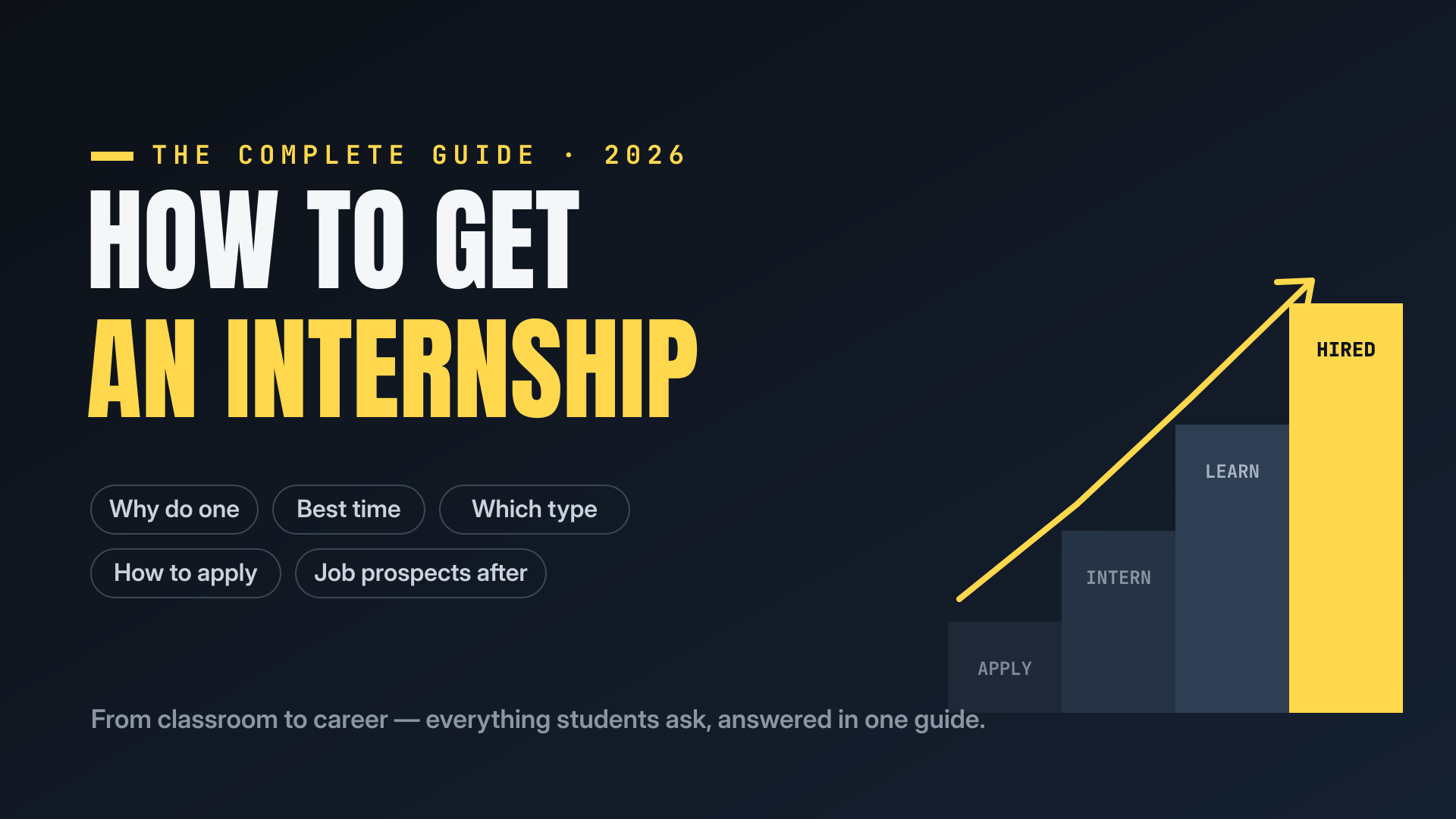
If you have ever typed “how to get an internship” into Google at 2 a.m. you are not alone. This is one of the searched career questions among students and freshers every single year.. There is a good reason for this. An internship is no longer something that’s just nice to have on your CV. In todays job market it is often the thing that makes the difference between a resume that gets shortlisted and one that gets skipped.
Here is what most guides will not tell you: getting an internship is not just about applying for it. It is about knowing why you are doing it when you should do it what type of internship to choose and how to convert it into a full-time job. This guide covers all of these things so let us dive in.
Why should you do an internship?
Think of an internship as a test drive for your career. You would not buy a car without driving it so why commit years of your life to a career path you have only read about in books?
What you learn in a classroom is theory. An internship teaches you everything. It teaches you how offices actually work, how it feels when you have deadlines, how to talk to your managers and whether the field you chose is really the field you want to be in. Many students find out during an internship that they love their industry more than they thought they would. Just as many students find out that they do not like their industry much as they thought they would.. That is a good thing to discover early on because it can save you years of being stuck in the wrong career.
There is also a truth. Employers today expect you to have experience even if you are a fresher. You have probably seen job ads that say ” role, 1-2 years experience preferred”. This is a joke that every job seeker has lived through. Internships are how you can break this loop. They are the way to get professional experience before you have a real job.
From a recruiters point of view. And I say this as someone who works in hiring. A candidate with even one solid internship is easier to place easier to interview and more confident in front of a client than a candidate without an internship. Internships are a way to get your foot in the door and they can really help you get a full-time job. An internship is a way to start your career and it can make a big difference, in your life.
Benefits of Doing an Internship
The benefits of an internship go far beyond the certificate you receive at the end. Here’s what you actually gain:
1. Real-world skills that classrooms can’t teach. Writing a college assignment and writing a client email are two different sports. Internships teach workplace communication, time management, handling feedback, and working in teams — the “invisible skills” every employer screens for.
2. A stronger, credible resume. Recruiters spend seconds scanning a CV. The word “intern” next to a real company name instantly signals that someone has already trusted you with responsibility. It moves you from “unproven” to “tested.”
3. A professional network before you graduate. Your internship manager, teammates, and even fellow interns become your first professional network. Years later, these are the people who refer you, vouch for you, and open doors that job portals never will. Referrals remain one of the strongest hiring channels in every industry.
4. Clarity about your career direction. An internship in digital marketing might teach you that you actually love analytics. A finance internship might reveal that you enjoy client interaction more than spreadsheets. This clarity is worth more than any stipend.
5. A shot at a pre-placement offer (PPO). Many companies use internships as an extended interview. Perform well, and you may walk out with a full-time offer before your final exams even begin.
6. Confidence. The first time you present in a real meeting, survive a real deadline, or get real appreciation from a manager — something shifts. You stop feeling like a student pretending to be a professional and start feeling like a professional who happens to still be studying.
What Type of Internship Should You Do?
Not all internships are created equal, and choosing the right type matters as much as getting one. Here are the main types of internships to consider:
Paid internships. The gold standard. Companies that pay interns tend to give them real work, real accountability, and real learning. The stipend is nice; the seriousness it signals is nicer.
Unpaid internships. Worth considering only when the learning, brand name, or mentorship is genuinely exceptional — for example, a niche role at a highly reputed organisation. If it’s unpaid and the work is just data entry, walk away.
In-office internships. Best for learning workplace culture, building relationships, and absorbing how professionals operate. If it’s your first internship, being physically present accelerates your growth dramatically.
Remote or virtual internships. Flexible and accessible — you can intern with a company in another city or country without relocating. Ideal for gaining experience alongside college, though you’ll need more self-discipline and proactive communication to stand out.
Summer internships. The classic 8–12 week internship during college breaks. Structured, competitive, and often the pipeline for pre-placement offers at larger companies.
Part-time internships during the semester. Fewer hours spread across months. Great for building experience continuously without sacrificing academics.
Research internships. Ideal if you’re considering higher studies or a career in academia, R&D, or specialized technical fields.
The right choice depends on one question: what do you want out of it? If you want a job offer, target companies known for converting interns. If you want exploration, choose variety. If you want skills, choose the role with the best mentor — not the biggest brand.
What Is the Best Time to Do an Internship?
Short answer: earlier than you think.
Most students wait until their final year to do their first internship. That’s a mistake. The best approach is to treat internships as a ladder, not a checkbox:
Second year of college: Do your first internship — even a small one. The goal here isn’t prestige; it’s exposure. Learn how workplaces function and figure out what interests you.
Third year (pre-final year): This is the most important internship of your life. Companies hire pre-final year students for summer internships specifically to evaluate them for pre-placement offers. A strong performance here can mean you enter your final year with a job already in hand.
Final year: Use internships to specialize, fill gaps, or pivot. If you’ve realized late that you want a different field, a final-year internship is your bridge into it.
Season-wise, summer (April–July) is when the largest number of structured internship programs run, so competition is high but so is opportunity. Winter internships (December–January) are shorter but less competitive. And remote internships have made timing far more flexible — many companies now hire interns year-round.
The real rule: the best time to do an internship was last semester. The second-best time is now.
How to Apply for an Internship (Step by Step)
Here’s how to actually land one, step by step:
Step 1 — Fix your resume first. One page. Clean format. Lead with skills, projects, and coursework relevant to the role. No internship experience yet? Highlight college projects, competitions, volunteering, or freelance work — anything that shows initiative.
Step 2 — Optimize your LinkedIn profile. Recruiters will check it. Use a clear photo, write a headline that says what you’re looking for (“Marketing student seeking summer 2026 internship”), and turn on the “Open to Work” setting for internships. Post occasionally about what you’re learning — it makes you visible.
Step 3 — Apply through multiple channels, not just one portal. Use internship platforms and job portals, your college’s training and placement cell, company career pages (many post internships that never reach portals), and LinkedIn’s internship filter. Applying through 3–4 channels multiplies your odds.
Step 4 — Use referrals and cold outreach. This is the step most students skip, and it’s the most powerful one. Message alumni from your college working at your target companies. Keep it short: who you are, what you’re looking for, and one specific question. A polite, well-written message to the right person beats fifty portal applications.
Step 5 — Customize every application. A generic “Dear Sir/Madam” cover letter gets ignored. Mention the company, the role, and one specific reason you fit. Two extra minutes per application dramatically improves your response rate.
Step 6 — Prepare for the interview like it’s a job interview. Because it is. Research the company, prepare a 60-second introduction, and have answers ready for “Why this role?” and “Why should we take you with no experience?” (Answer: your projects, your eagerness to learn, and your availability to contribute from day one.)
Step 7 — Follow up professionally. No response in a week? One polite follow-up is not desperate — it’s professional. Recruiters juggle dozens of roles; a follow-up often surfaces your application from the pile.
Job Prospects After an Internship: What Actually Happens Next
This is where internships quietly change the trajectory of your career.
The most direct outcome is the pre-placement offer. Companies increasingly prefer converting interns to hiring unknown freshers — the intern is already trained, already tested, and already part of the team. For the company, it’s a low-risk hire. For you, it’s a job secured before graduation.
Even without a PPO, the market treats you differently. Candidates with internship experience typically get shortlisted faster, interview better (because they have real stories to tell instead of textbook answers), and negotiate better starting offers. When a recruiter compares two freshers — one with two internships and one with none — the choice is rarely difficult.
Internships also compound. Your first internship gets you a better second internship. Your second gets you a better first job. Your first job gets you everything after. The earlier you start the chain, the further it takes you.
And there’s the invisible benefit: every internship leaves behind people who know your work. A manager who liked you three years ago becomes a referral tomorrow. In hiring, that’s how most “lucky breaks” actually happen — they’re just old impressions paying off.
FAQ
Anywhere from 6 weeks to 6 months. Two to three months is the sweet spot — long enough to learn and deliver something real, short enough to fit around academics.
Yes — that's exactly what internships are for. Lead with college projects, skills, and enthusiasm. Every professional you admire once applied for their first internship with an empty resume too.
Only if the learning or brand value is exceptional. Never accept unpaid work that involves no real mentorship or skill-building.
Two to three quality internships is ideal. One for exposure, one for depth in your chosen field, and optionally one to specialize or pivot.
No internship guarantees a job — but a good internship, done well, dramatically shortens the distance to one.